Skip to main content

A land survey for fence installation is a licensed surveyor’s measurement of where your property lines run, marked on the ground so the fence goes on your side of them. Angi’s St. Louis figures run from about $500 for a small lot to $3,200 for a fence-land survey, and a recent survey you already own can sometimes do the job.
This guide covers whether you need a survey, how to find one you may already have, what a survey costs and how to hire a surveyor. Once your line is marked, we will measure your yard and give you a written price for fence installation in St. Louis.
Get your line marked by a licensed surveyor before you sign for a fence.
We build on the line your survey shows. We cannot decide where your property ends, and neither can a tape measure, a neighbor’s fence or an online map.
- Your property line. Only the survey shows where it runs.
- Corner pins. The surveyor finds or sets these markers.
- Your fence. It goes on your side of the line, with room for the posts.
Do You Need a Survey to Build a Fence in Missouri?
Whether a survey is required depends on who is asking. Fence permits and setbacks are set locally, by your city, county or village, so a call to the permit office for your address settles the first question. Four different parties can ask for a survey, and each has its own reason.
Your city or village
Why: Some cities want a survey, or a to-scale drawing of your lot with the fence marked, before they issue a permit.
What to do: Call the permit office for your address and ask which one they accept. Our guide to fence height regulations covers the height limits.
Your homeowners association
Why: Many ask for a survey, or a plot plan that shows the fence line, along with your request.
What to do: Our HOA fence approval guide lists everything to put in the packet.
Your fence installer
Why: When any part of the fence runs along a property line, our FAQ asks for the stake survey before the estimate.
What to do: Other installers set their own rules, so ask before you sign anything.
You, for your own protection
Why: A fence built even inches onto a neighbor’s land can start a dispute and have to be moved, as a Minnesota surveying firm explains.
What to do: A survey is your proof of where the fence belongs.
If no one else asks, a survey is still the only way to know the line. A fence is permanent, and moving one means paying for the labor and the materials twice, as a Virginia surveyor points out.
You do not need a new survey when you already hold a recent boundary survey, every corner pin is in the ground and nothing near the line has changed. Your city or HOA may still ask for a drawing, and a mortgage or closing survey is a different paper, as the next sections explain.
Do I Need a New Property Survey for My Fence? Tap Your Situation
Answer four questions to see what to do next. The answer is a starting point and not legal advice, and your permit office and your HOA have the final word.
| If this describes you | Do this |
|---|---|
| The fence will sit on the line or within a couple of feet of it, and you have no survey or only a plot plan. | Order a boundary survey or a fence-line stake-out. |
| The fence will sit near the line and you have a mortgage or closing survey. | Ask a surveyor whether it can be used. It was made for your lender and may not be precise enough. |
| The fence will sit near the line, you have a signed and sealed boundary survey and you can find every corner pin. | Your survey is probably enough. Show it to the surveyor or to us and ask whether the pins still match. |
| You can find only some of the pins, or none. | Pins can be moved or buried, so a pin you find is a clue and not proof. Ask a surveyor to check them. |
| The fence will sit several feet inside the line and you have a recent survey. | A new survey is optional. Keep the survey with your fence papers. |
| Your city or HOA asked for a drawing. | A survey, or a plot plan with the fence line drawn, is the usual answer. Ask which one they accept. |
Survey, Plot Plan or Parcel Map: What Each One Tells You
People use the word survey for several different papers, and only one of them shows where to set fence posts.
| Paper | What it is | Can you place posts by it? |
|---|---|---|
| Boundary survey | A signed and sealed drawing from a licensed surveyor, with the corners found or set. Missouri’s boundary survey standards cover these. | Yes. |
| Mortgage or closing survey | A survey made for the lender to show the house on the lot. One Virginia surveyor says it is often too rough to place a fence by. | Not by itself. Ask a surveyor whether it can be relied on. |
| Plot plan | A drawing made before or during building. The same Missouri standards list plot plans among the drawings they do not apply to. | No. It is good for a rough price only. |
| Online parcel or tax map | Missouri’s rule for parcel maps says they do not represent a boundary survey and cannot be used to establish property boundaries. | No. |
| A neighbor’s fence, a hedge or the mowing line | It shows where someone built or mowed. Mowing to the same spot for years does not make it the line. | No. |
A boundary survey is held to a tight standard. For urban property, Missouri limits random error to 50 parts per million or one-tenth of a foot (about 1.2 inches) on lines under 2,000 feet, at a 68 percent confidence level (20 CSR 2030-16.040). A mowing line or an old fence can be off by feet.
How to Find an Existing Property Survey in St. Louis
Before you pay for a new survey, look for one that already exists. Work down this list.
- Your closing papers. Lenders and insurers often ask for a survey when you buy, so look in your closing packet first. Then ask your title company or the previous owner, as Angi suggests.
- The recorded plat for your subdivision. The St. Louis County Recorder of Deeds records subdivision plats, and its recorded documents are open to public research. The public research line is (314) 615-7100, and the office is at 41 South Central in Clayton. In the city, use the City of St. Louis Recorder of Deeds. A plat shows the lot lines as drawn when the subdivision was created. A surveyor still has to find those lines on the ground, but a surveying firm advises sending the deed and the plat with your request to keep the bill down. Angi says a copy of a plat or zoning record usually costs under $25, so ask for the paper before you order a new survey.
- The state’s land survey index. The Missouri Department of Agriculture’s Land Survey Program holds about two million survey documents, and its Land Survey Index covers St. Louis County as well as St. Louis City. The search form asks for a surveyor’s name, a township, range and section, or a date range, so keep your deed and your closing survey nearby. The index notice says records recorded after 1969 are requested from the recorder of deeds office where they were recorded. The program answers questions at 573-368-2300.
- A neighbor’s surveyor. Ask a neighbor who had a lot surveyed lately. That surveyor may already have the nearby corners on file.
- The pins in the ground. Look along the curb and the back of the lot for iron pins. Angi warns that a utility crew can move them, so a pin is a clue and a surveyor’s check is the proof.
If you find a survey, look at its date, whether it shows your whole lot and whether a licensed surveyor signed and sealed it. A short call to a surveyor will tell you whether it can be used. If you find nothing, you need a new one, and the next section shows what that costs.
How Much a Land Survey for Fence Installation Costs in St. Louis
Published survey prices disagree by a wide margin, so here they are side by side, with the source of each. Every figure was read on October 13, 2026. Only the top four are priced for St. Louis, and the rest are marked so you can see where each one comes from.
Green band: $500 to $1,000, our reading for a small platted lot with the pins in place. It is not a quote.
We lined the published figures up and found that the numbers differ for a reason. Angi says its local figures start from national cost data and are adjusted with a federal regional price index. That makes them estimates for St. Louis and not St. Louis quotes.
The Angi St. Louis figures also include bigger jobs, such as title surveys and topographic maps. The surveyor and Thumbtack figures describe small lots in platted subdivisions, but they are not St. Louis prices. One comes from a surveyor in Cleveland, Ohio, and the other is a national average.
Our reading of the table is not a quote. A small platted lot with the pins in place often falls around $500 to $1,000, and a large, wooded or older lot costs more. We could not find a St. Louis surveyor that publishes a fence survey price, so get two written quotes.
Lot size, hills and trees, missing or moved pins and the amount of deed research all move a quote. Angi lists surveyor rates of $100 to $200 an hour, so every hour of deed research or brush clearing shows up in the bill. Angi also lists a fence-land survey as its own, lower-priced type, so ask whether your quote covers a full boundary survey or only the fence line.
Thumbtack’s guide adds that large boundary areas are sometimes priced by the foot, at about 50 to 70 cents a foot, and that some surveyors charge a minimum fee.
The survey is separate from the fence itself. For fence prices, see our guides to vinyl fence cost and aluminum fence cost.
How to Get Land Surveyed for a Fence
Once you know the steps, ordering a survey is a short process.
- Sketch your fence route. Mark the sides the fence will run along and where you want gates on a copy of your plat or a simple drawing.
- Gather your papers. Send the deed and the recorded plat with your request, because surveyors work faster with them.
- Find licensed surveyors. The Missouri Society of Professional Surveyors has a find a surveyor tool that searches by zip code or county. Neighbors and the Better Business Bureau are other places to check.
- Get two written quotes. Use the questions below so the quotes can be compared.
- Show the survey to your neighbors. Sharing the result before the fence goes up prevents misunderstandings.
- Give a copy to your fence installer. The installer needs it before the final measurement.
Questions to ask a surveyor before you hire one
- Is this a full boundary survey or a fence-line stake-out?
- Will you set or flag pins along my fence route?
- Will I get a signed and sealed plat, or only a sketch?
- Does the plat show easements?
- What is the price, and what is the delivery date, in writing?
Call Maintenance-Free and ask for our survey recommendation.
You cannot set the line yourself from a deed and a tape. A mistake of a few inches is the whole problem, and only a licensed surveyor stands behind the result.
What We Do With Your Survey on Fence Day
We do not do surveys. We build where your surveyor marks the line, and our process is built around that.
When any part of your fence runs along a property line, our estimate instructions ask for the stake survey first. The estimator measures against the marked line and comes back for a final measurement once the line is staked.
If your yard is not staked yet, a to-scale plot plan gives only a close approximation of the footage. The same page adds that an owner who skips the survey takes on full responsibility for where the fence goes.
On installation day, the crew walks the layout with you before the first post goes in.
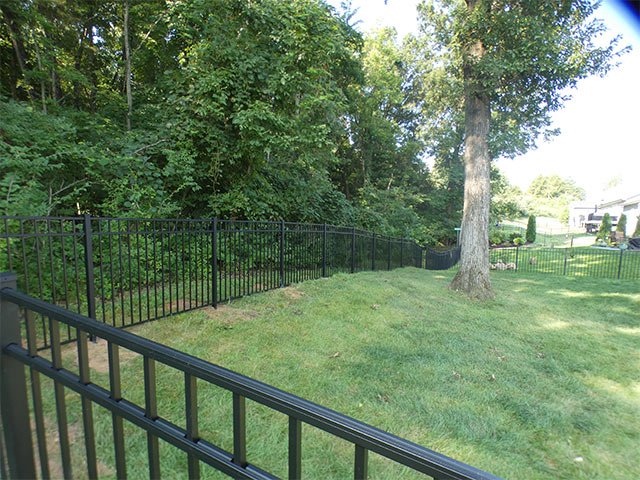
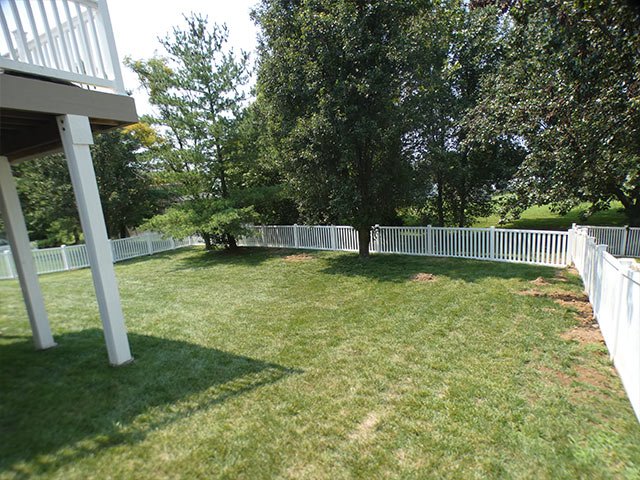
On a Windswept Farms aluminum fence in Eureka in August 2026, that walk took longer than usual. The homeowner had HOA questions about the property lines, and everyone confirmed the placement before work began.
On an Imperial vinyl fence in July 2026, the homeowner chose to set the fence line farther inside the property than usual to protect a neighbor’s sprinkler line along the side. The crew finished in two days without hitting it.
We install aluminum, vinyl, steel and composite fences, and each one goes along the line your survey shows.
Call 811 Before the Digging, Even With a Survey
A survey shows your boundaries and recorded easements. A survey will not show the gas, water, electric and data lines buried in your yard.
The Missouri Public Service Commission says to call 3 to 10 days before excavating, and it names fences and decks as projects that need the call. Missouri 811 says a locate request is free. You can submit it online or by dialing 811, and it is worth asking who is making the call before you sign.
Fence Survey Checklist: What to Have Ready
Check off each item as you go. The ticks stay on this device, and you can print the list to bring to the estimate.
- I found my deed and my closing papers.
- I have the recorded plat for my subdivision.
- A licensed surveyor has marked or flagged the corners along my fence route.
- My survey shows the easements: utility, drainage and access.
- I drew the fence route and the gate openings on a copy of the survey or plat.
- I asked my city whether it wants a survey or a drawing with the permit.
- I checked my homeowners association rules.
- My neighbors have seen the survey.
- Missouri 811 has my locate request, 3 to 10 days before digging.
- A copy of the survey is ready for the estimator.
This guide is not legal advice, and it does not replace a surveyor or your permit office. If you are already in a boundary dispute with a neighbor, start with a licensed surveyor and a lawyer, because a fence company cannot settle it.
Ready for a fence price on a surveyed line? Schedule an on-site estimate and we will measure to the line your surveyor marked.
Schedule an on-site estimate Would you rather call? Dial 636-464-1144
Our estimate visit costs nothing and carries no obligation. Our fence work in St. Louis goes back to 1994, and you can read about the Maintenance-Free Advantage or meet Tim Kelley and our team before you call.
Fence Survey Questions, Answered
How old can a survey be and still work for a fence?
There is no set age, and a survey stays useful while the pins are in the ground and nothing near the line has changed. James River Surveying warns that older surveys can miss moved markers, and one Tennessee fence company suggests a fresh one for homes older than 20 years. A surveyor can compare an old plat with the ground in a short visit.
Who pays for the survey when the fence runs along a shared line?
The owner who orders the fence usually pays, according to one Pennsylvania fence company, and neighbors can split the cost if they agree. Angi suggests a written lot line agreement when two owners want to settle the line without hiring lawyers. Put any cost split in writing before the surveyor is hired.
How long does a fence survey take?
A fence survey takes as long as the surveyor’s schedule and your lot require. One Tennessee fence company reports three to seven business days from the start of fieldwork, and a surveying company says a few weeks from booking is common for standard lots. Ask for a delivery date in writing, and book the survey before you order the fence.
What if the survey shows my old fence is over the line?
Talk to your neighbor first and bring the survey. James River Surveying says a fence that has sat over the line for years should be dealt with before you replace it, because a new fence in the same spot repeats the mistake. The usual fixes are moving the fence or signing an agreement with the neighbor, and a lawyer can advise on your own case.