Skip to main content

A privacy fence in the St. Louis area is normally 6 feet tall, and most municipalities let you build to 6 feet without a variance. Go taller and you are usually asking permission. That is the short answer, and that one rule settles more designs than any style choice does.
So the good privacy fence ideas all start in the same place. Height first, then the gap between the boards, then the look. Do it in that order and nothing has to come back down.
Maintenance-Free Outdoor Solutions installs these across St. Louis and the Metro East. See how we run a privacy fence job in St. Louis. Reach us at 636-464-1144 to have someone walk your property line and confirm your municipality’s rule before anything gets ordered.
A screen is not always the answer. If you only want to block one window or one sight line, a 20 foot run beside the patio does more for the money than wrapping the whole yard. You do not need to enclose four sides to get privacy where you actually sit.
How Tall Should a Privacy Fence Be?
Most backyard runs here are 6 feet. That height clears the eye line of someone standing in the next yard, and it is the tallest most local codes allow by right.
Front yards are different. Many municipalities cap anything in front of the house at 4 feet, and some set it at 3.
Going above 6 feet is a permission question, not a product question. On the Bryant job in Wildwood, 31 August 2026, the homeowner already had a 4 foot fence. A pool went in, 4 feet no longer screened the yard, and they wanted 6. The city had to sign off on the taller line before a single panel was ordered. It went in at 104 linear feet in 2 days.
The test I use on an estimate: stand where you actually sit, not at the property line. Have someone hold a tape at 6 feet along the fence line and look at it from your chair. Half the time the answer is that 6 feet is plenty and the money is better spent on a longer run.
How Closed In Do You Want It?
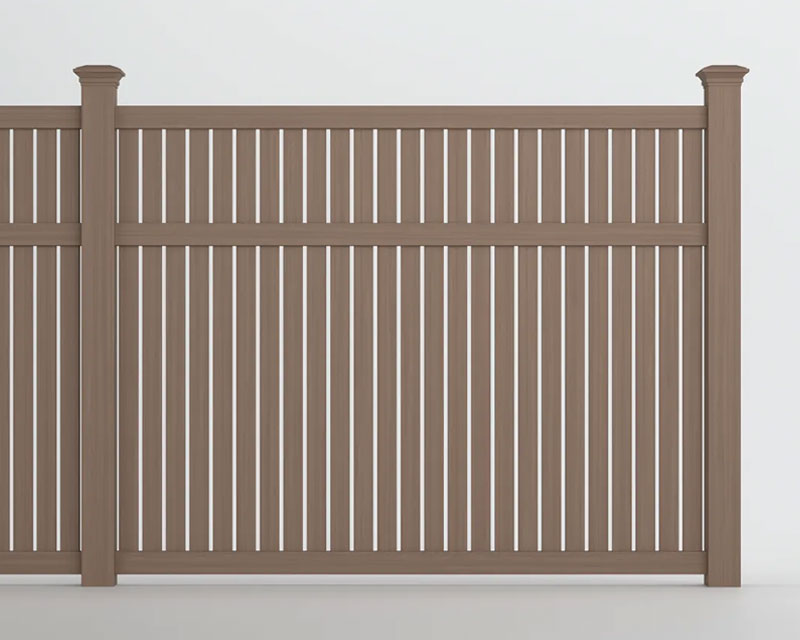
How closed in you want the yard is the part most people skip, and it changes the feel of a place more than color does.
Solid. Boards butt together with no gap. Nothing sees through it and no wind passes through it either, which is why these panels need a proper wind rating in open ground.
Semi-private. Boards with a narrow gap, usually an inch or two. You get most of the screening, plus light and air. From twenty feet away it reads as solid.
Picket and spaced styles. These are not screens. The Norwalk style uses a 3 inch picket with 3 15/16 inch spacing. That contains a dog or a child without closing the yard in. On the Voegtli job in Kirkwood we dropped an aluminum fence to 1 5/8 inch spacing for two small dogs. Good containment, no privacy at all.
Be honest about which one you want. A homeowner who says “privacy” and means “keep the dog in” ends up paying for solid panels that were never necessary. Spaced pickets cost less and do that job properly.
Seven Looks, Ordered by How Much They Actually Screen
These are the seven we stock, and all four of the 2026 jobs further down this page used one of them. They are listed from most closed in to least, because that is the decision, and the one people get wrong. Two of them will not pass pool code around here, which is flagged where it applies.
Every one of them is Catalyst, the Barrette Outdoor Living line, and our listing is public on the installer directory, so you can verify it yourself rather than take our word for it.
1. Solid smooth, for a clean modern line

Flat boards, no texture, nothing to read from ten feet away. It disappears behind planting, which is what you want when the garden is the feature and the fence is only the edge.
Screens: everything. Colors: white, almond, gray, clay. Pool code: passes.
2. Solid woodgrain, for the look of stained cedar

Grain in the surface and a mixed color rather than a flat one, so it reads as stained wood from the patio. There are two ways to get this look and they are not the same product:
In vinyl it comes in Arctic, Brazilian, Sierra and Weathered Blend. In moulded composite, reinforced with galvanized steel, it comes in Walnut Brown, Red Cedar, Nantucket Gray and Dark Gray Oak, with wider boards and a deeper grain. Stand a foot away from the composite and it still reads as sawn timber. Stand back twenty feet and most people cannot tell the two apart, which is worth knowing before you pay the difference.
Screens: everything. Pool code: both pass.
3. Stone look, for a wall without the masonry
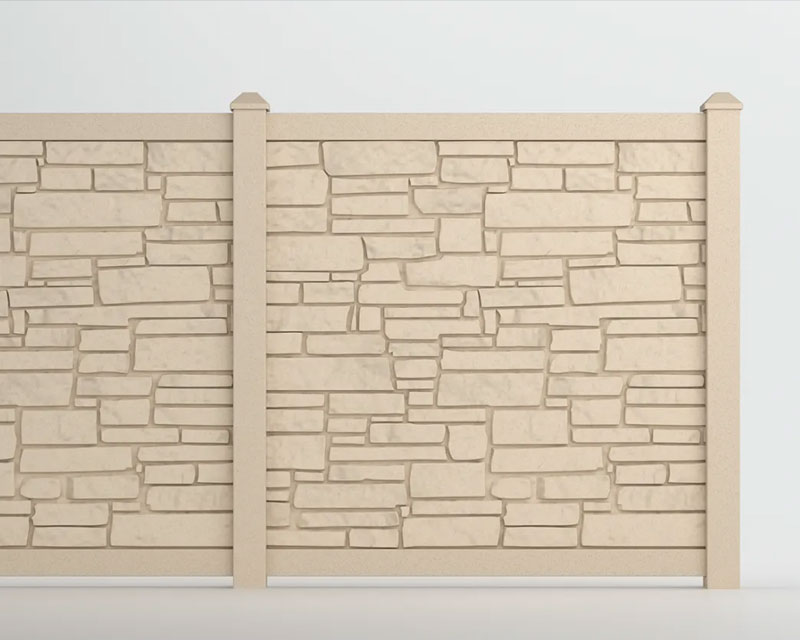
Moulded composite pressed into a dry stone pattern, reinforced with galvanized steel. At roughly three times the weight of a vinyl panel it is the heaviest thing we hang, and of the seven it is the best at knocking down road noise. On a corner lot facing traffic it is the one that earns the difference.
Screens: everything, plus a good deal of sound. Colors: Beige, Brown, Gray, Dark Gray and Dark Brown Granite. Pool code: passes.
4. Privacy with a lattice top, for height without the wall
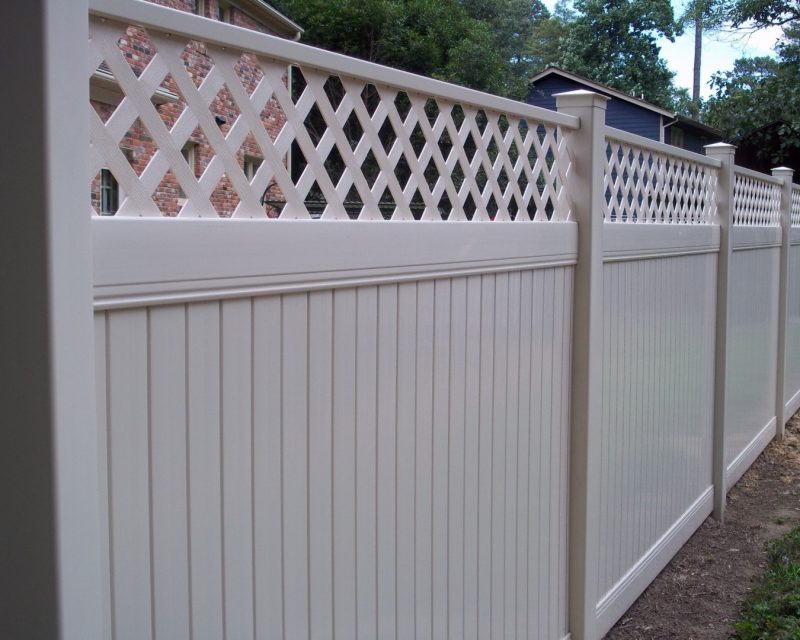
Solid panel where it matters, open diamond lattice across the top. You keep the full height and the screening, and the top section still passes light, so a narrow side yard does not turn into a corridor. It is the one people land on when a full 6 feet of solid vinyl feels like too much fence but 4 feet is not enough.
The style we build this on is New Lexington, with a lattice accent. A Victorian spindle accent is the other option if diamonds are not the look. It carries a V groove picket and a curved deco rail, so the solid half is not a flat slab either.
Worth knowing on a slope. On the Harvengt run in Collinsville, 1 May 2026, we racked all 84 feet in our own shop so the pickets stayed vertical while the rails followed the ground. Stepping the panels instead would have left a triangle of daylight under each of the three sections, and on both the Harvengt and Morris jobs that gap is exactly what we were protecting against, since a dog finds a stepped opening inside a week.
Screens: everything below the lattice. Colors: white and almond. Pool code: the lattice openings and the rail height are both things an inspector looks at, so confirm the exact panel with your municipality before you order.
5. Wide boards with thin slits, for privacy that still breathes
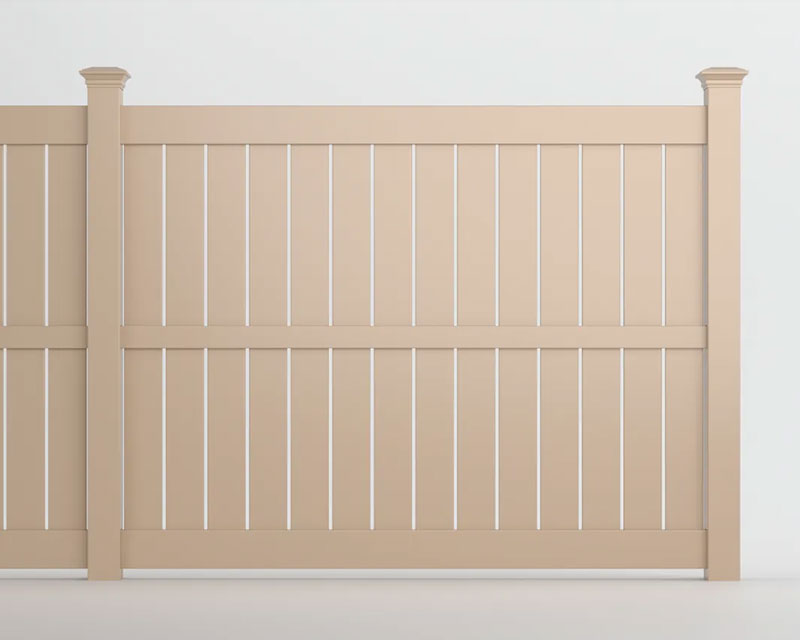
Wide boards with a narrow slit between each one and a rail across the middle. From the patio it reads as solid. Stand close and you get thin lines of daylight, and the yard gets air moving through it.
One thing to know: that centre rail is a foothold, so this style is not pool-code compliant in most Metro St. Louis municipalities. Lovely fence, wrong side of the code if it is going around water.
Screens: nearly everything. Colors: white, almond, gray, clay. Pool code: no, in most municipalities here.
6. Shadow-box, for a fence with no back side
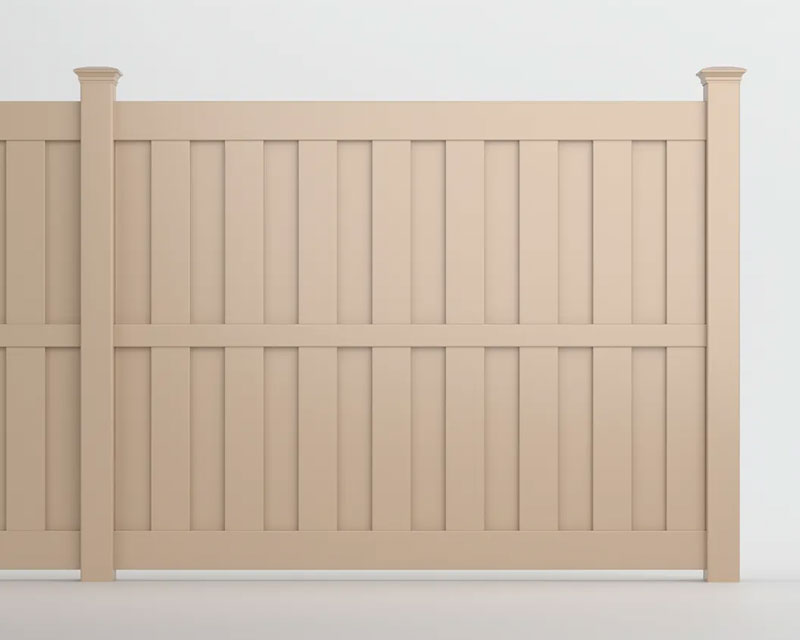
Pickets alternate front and back of the rails, so it looks the same from your side and your neighbor’s. Nobody gets the good side, which settles an argument before it starts. Straight on it screens; walk along it and you catch glimpses between the boards.
Comes at 4 feet and 6 feet, or as a 4 foot 8 section with a 1 foot 4 lattice top if you want the height without the mass.
Screens: most of it, from straight on. Colors: white, almond, clay. Pool code: no, in most municipalities here.
7. Spaced slats, for a boundary that marks the line
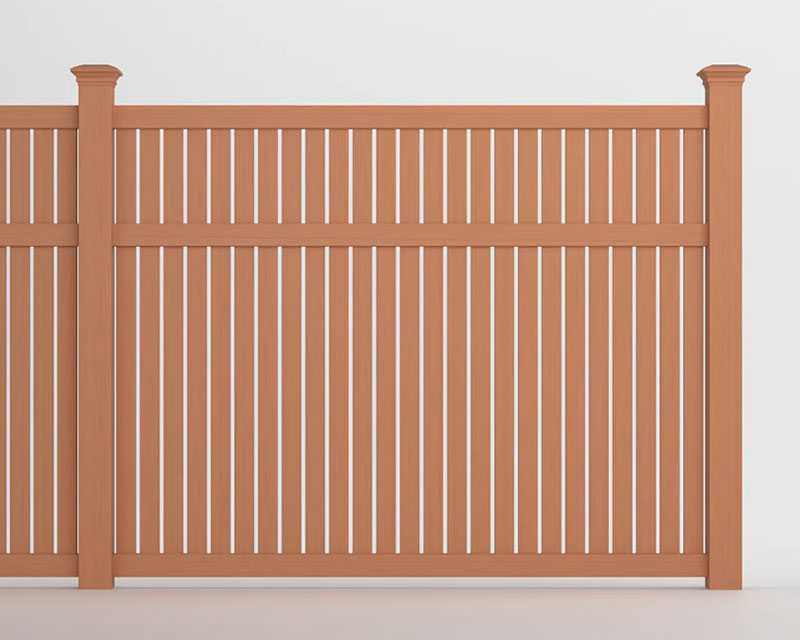
A 3 inch picket, 7/8 of an inch deep, set 7/16 of an inch apart. Because the pickets are deeper than the gap is wide, it screens well from an angle and you can see through it standing square to the line. Air moves through it, which matters on an exposed run.
Screens: from an angle, not head on. Colors: white, almond and four woodgrain blends. Pool code: passes.
White is what buyers expect and the safest on resale. Almond and clay hide dust better through a dry August. Whatever you are drawn to, hold the sample against your own siding in daylight before you order, because these colors move a lot between a showroom and a west-facing wall at four in the afternoon.
What they are made of, and what that costs you
Five of the seven are vinyl. It does not rot, it does not need paint, and a wash with the hose once or twice a season keeps it looking new. The stone look and the composite woodgrain are a moulded composite over galvanized steel: heavier, dearer, and better at sound.
Aluminum is not on the list, on purpose. It never screens anything. It is the right answer for a pool or a pet yard and the wrong one if the point is not being seen.
Still weighing vinyl against a wood fence? We put the two side by side here.
Four Ways to Lay It Out
1. Break the run into sections. On the Harvengt job in Collinsville, 1 May 2026, the homeowner wanted the patio screened and the rest of the yard open. Instead of one unbroken line we set three separate runs and left the existing shrubs standing between them. 84 linear feet, 6 feet tall, finished in 1 day. It looks designed rather than walled.
2. Screen the sight line, not the boundary. Work out what you are actually blocking. Often it is one upstairs window or one patch of road.
3. Match what the neighborhood already has. Subdivisions with approved styles are common here. On the Criscione job in Eureka the homeowner lives in Windswept Farms, where the style is set, so we matched the neighbor’s fence closely enough to pass.
4. Match phase one before you build phase two. Yards get fenced in stages. On the Morris job in Arnold we had to find a white panel that matched an earlier run. It is easier to match a style while it is still in production than five years later, so write down the maker and the style when the first phase goes in.
Four Privacy Fences We Built This Year
- Harvengt, Collinsville IL, 1 May 2026. 84 linear feet, 6 feet tall, woodgrain vinyl in Arctic Blend, 1 day. Split into three runs around the existing shrubs.
- Morris, Arnold MO, 30 May 2026. 232 linear feet, 6 feet tall, white vinyl, 3 days. Matched an earlier phase and worked around rain.
- Rogers, St. Louis city, 25 June 2026. 61 linear feet, 6 feet tall, white Supreme style, 2 days. Narrow lot, old fence to pull first.
- Bryant, Wildwood MO, 31 August 2026. 104 linear feet, 6 feet tall, 2 days. Replaced a 4 foot fence after a pool went in, with city approval for the extra height.
The pattern in those four: none of them was slowed by the panels. Three were slowed by what was already in the ground, and one by the weather.
What Actually Slows These Jobs Down
Whatever the last fence left behind. On the Rogers job we found old concrete pods that the previous posts had been set in. Every one had to come out before a new post went in. On the Morris job the sonotubes had been sunk too deep to use, so we reset them.
Rain. Post holes in wet clay are a bad idea and Missouri clay holds water for days. The Morris job was scheduled around a wet stretch on purpose.
Finished landscaping. A mature yard means hand work around beds and plantings. It is not a problem, it is a slower day.
What none of that changes is the material. A panel is a panel. The ground is where the time goes.
What Drives the Price
Four things, roughly in order: how many linear feet, how tall, how many gates, and what is in the ground already. Material matters less than people expect, because the labor is similar either way.
We keep current St. Louis figures on their own page so they stay accurate: fence pricing for the St. Louis area.
Where this advice stops. A fence does not fix a drainage problem, and it will not hold a retaining wall. If your line runs along a slope that moves, or across an easement, that is a site question and not a catalog question. Get someone on the ground before you pick a style.
Frequently Asked Questions
How tall can a backyard fence be in the St. Louis area?
Six feet in most back yards, and often 4 feet or less in a front yard. Anything taller than 6 feet usually needs approval from your municipality. Rules are set locally, so confirm yours before you order.
What is the most attractive privacy fence style?
Woodgrain vinyl is the one homeowners react to most on our estimates. Its grain pattern and blended tones mimic stained cedar convincingly, without ever needing the stain. Stone-look composite is the other one people stop and look at, and it costs more.
What fence color adds the most value?
White is the safest resale color and the one buyers expect, and tan and almond hide dust better on a dry summer. A color that clashes with the house costs you more than the color choice saves. Look at the sample against your siding in daylight, not in a showroom.
How do you block a neighbor’s view of the backyard?
Find the window or the deck you are being seen from, then stand where you sit and look back at it. You usually only have to screen that one line. A 20 or 30 foot run in the right spot beats wrapping the whole yard, and it costs a fraction as much.
What can you use instead of a fence?
Planting, a pergola with a side panel, or a screen wall on one side of a patio. Planting takes years to fill in and needs watering, so it is a long game rather than a fix. If you need it screened this season, build something.
How much does a 200 foot run cost?
The price of a 200 foot run depends on height, gate count, and what the old fence left in the ground. Those figures live on our St. Louis pricing page, updated as costs change. See our fence pricing guide for St. Louis.
Where to Start
Five steps, in this order:
- Check the height rule for your municipality, front yard and back yard separately.
- Stand where you sit and work out which sight line you are actually blocking.
- Decide how closed in you want it: solid, semi-private, or spaced.
- Pick the material and the color, with a sample held against your own siding in daylight.
- Find out what is in the ground where the old fence stood, before the date is booked.
Follow that order and nothing gets sent back or torn down after the fact.
Would rather leave the code side to us? We will measure your line, confirm the height rule with your municipality, and hold samples against your own siding before anything is ordered. Homeowners around St. Louis have shared their own experience working with us on our reviews page.
The install comes with our one-year workmanship guarantee, on top of whatever warranty the panel maker offers, and the free visit typically lands within 1 to 4 days. You can also handle a sample panel yourself at our Arnold showroom.
Call 636-464-1144 to get that visit scheduled, no cost to you. If you already know you want vinyl, start on the vinyl installation page instead.