Skip to main content

An invisible fence costs about $1,600 to have installed around St. Louis. Most homeowners pay $950 to $2,500, based on Angi’s local cost figures updated in July 2026. The system is a buried wire or wireless signal, plus a collar that beeps, then corrects, at the line. A real aluminum fence usually runs $3,750 to $6,000 for a 150-foot backyard line. That is about 2 to 4 times as much. It also keeps other animals out, not just your dog in.
Maintenance-Free Outdoor Solutions has put in fences around St. Louis since 1994, a year anyone can check on our BBB profile. Barrette Outdoor Living lists us on the installer finder for its Catalyst fence brand. What we install is aluminum, vinyl, ornamental steel and composite, and our showroom is in Arnold. We do not sell or install invisible fences. So the collar prices here come from Angi, and the safety points come from VCA Animal Hospitals. The fence prices come from our own published cost pages.
If you already know you want a physical fence, see how we work as a dog fence company. You can also call 636-464-1144 for a free estimate visit. Panels, gates and picket spacing are on display at our Arnold showroom.
What an Invisible Fence Costs
People also call it an electric fence, an underground fence or a hidden fence. Each one works the same way: a collar on your dog warns, then corrects, near a line you cannot see.
Angi’s figures for St. Louis were updated in July 2026. We do not install these systems, so we cannot quote one ourselves.
| What you are buying | Angi’s figure |
|---|---|
| Professional install, St. Louis average | $1,600 |
| What most St. Louis homeowners pay | $950 to $2,500 |
| Wireless system | about $350 |
| Wired system, buried in the yard | about $1,000 |
| GPS collar system | about $2,000 |
| Do-it-yourself kit | $200 to $700 |
| Buried wire, installed | $2 to $4 per foot |
| Each extra collar | $50 to $150 |
| Batteries, flags, wire repairs | $10 to $50 each |
Yard size moves the price, because a bigger yard means more wire in the ground. Angi puts a yard of up to a quarter acre at $700 to $1,200. The largest yards on its chart run $2,000 to $3,500.
Invisible Fence Brand, the company the product is named after, posts no prices. Its pricing page sends you to a local dealer for a quote. The same page claims its system saves 45 to 80 percent over a traditional fence on a quarter acre.
The spending does not stop on install day. Every dog needs its own collar. Most collars run on batteries. A cut wire is a repair bill. With 2 dogs, those small costs come back every year.
What a Real Fence Costs Around St. Louis
Installed aluminum runs $20 to $45 a linear foot, a national range from our aluminum fence cost page. That page puts the St. Louis area average at $5,000 for a whole fence. Most homeowners pay $25 to $40 a foot, per our aluminum fence page. Aluminum keeps the yard open to the view and never needs paint.
- Length: most home fences need 100 to 200 linear feet.
- 100 feet at $25 to $40 comes to $2,500 to $4,000.
- 150 feet comes to $3,750 to $6,000.
- 200 feet comes to $5,000 to $8,000, or $4,000 to $9,000 across the full $20 to $45 spread.
Gates are priced on top of the per-foot figure. Our aluminum fence cost page splits the price into materials, labor and removal of an old fence.
Set side by side, a 150 foot fence costs about 2 to 4 times the $1,600 invisible fence average. After that, the fence has no collars, batteries or buried wire to replace.
Putting up a fence yourself? The fence supply store side of our business sells the materials for your own install.
What the Extra Money Buys You
On a 150 foot yard, a fence costs roughly $2,000 to $4,500 more than the invisible fence average. That money buys five things.
A fence keeps other animals out
The collar only works on your dog. A loose dog, a coyote or a child from down the street can walk straight in. Your dog cannot get away from them. With a collar system, you cannot stop a stray from coming into your yard.
A fence works with the power off and the battery dead
VCA Animal Hospitals points out that a cut wire or a dead collar battery can leave the boundary open. A fence stands there whether anything is charged or not.
A fence holds a dog that really wants to go
VCA also warns that a dog set on chasing something, or scared by thunder, may run straight through the boundary. Some systems then correct the dog on the way back in, which is the opposite of what you want. Nobody runs through a 4 foot aluminum panel.
A fence works on day one
A collar system only works after training. You walk your dog along a line of small flags until it learns where the boundary is. A fence works the day it goes in.
A self-closing gate covers the one thing collars do well
A collar system has no gate to leave open, and that is a fair point in its favor. The fix is gate hardware that shuts and latches by itself. Elite offers self-closing, self-latching gate hardware on its aluminum. A gate that latches on its own cannot be left open by a visitor.
When an Invisible Fence Is the Better Buy
A collar system is the right call in a few narrow cases.
- Your subdivision does not allow a fence at all. Ask before you decide, though. Many allow a fence in one approved style, like the Criscione yard below.
- You have a calm dog and a budget under $1,000. A dog that already stays close is the easiest case.
- The ground is too big to fence. Buried wire runs $2 to $4 a foot against $20 to $45 for aluminum, so on several acres the gap gets wide.
A collar system is not for a dog that chases, bolts at storms, or has gotten out before. And you do not need one if other animals coming in is your worry, because it will not stop them.
My advice, if your dog has ever pulled loose to chase something: skip the collar and fence the yard. For help choosing a material, our guide to fences for dogs compares them.
Do Invisible Fences Hurt Dogs?
VCA says the collar gives a warning sound first. The correction that follows startles the dog rather than hurting it, as long as the collar is set properly.
So the setting matters, and it is yours to get right for each dog. A sensitive dog and a stubborn one will not need the same level. With a fence, there is no setting to get wrong.
Dog Yards We Have Fenced, and What Each One Needed
Each of these jobs answers a question people ask about keeping a dog in without a collar.
Can a small dog squeeze through the pickets?
Not if the gap is closed. At the Voegtli home in Kirkwood, two small dogs needed a tighter fence. We set the pickets 1 5/8 inches apart. The run was 38 linear feet of 4-foot matte black aluminum fence with 2 gates. We put it in on May 15, 2026, in 1 day.
One gate crossed a concrete walk. Rather than break up the walk, we fastened a Screw Boss post straight onto the concrete for that gate.
Will a fence block the view of my yard?
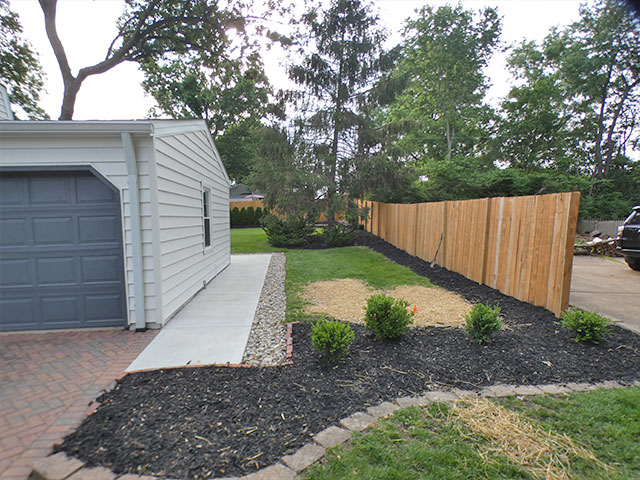
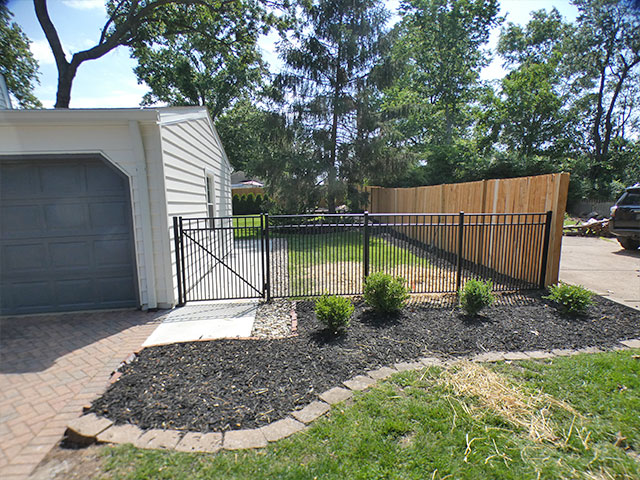
Not an open one. The Stowe yard in Brentwood had finished landscaping the owners wanted to keep seeing. Pickets set 3 11/16 inches apart held the dogs and kept the view.
Brentwood required a hole inspection before the posts went in. Our scheduler booked it, and it passed. On May 14, 2026, the 100-foot run, 4.5 feet tall, went in start to finish in 1 day. The plants came through without damage.
What if the yard is on a hill?
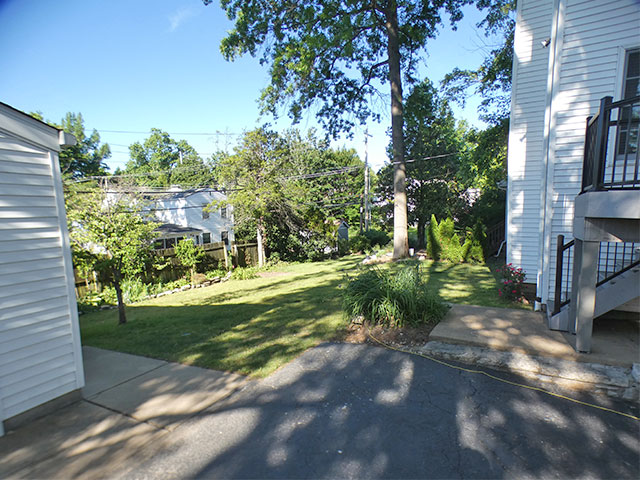
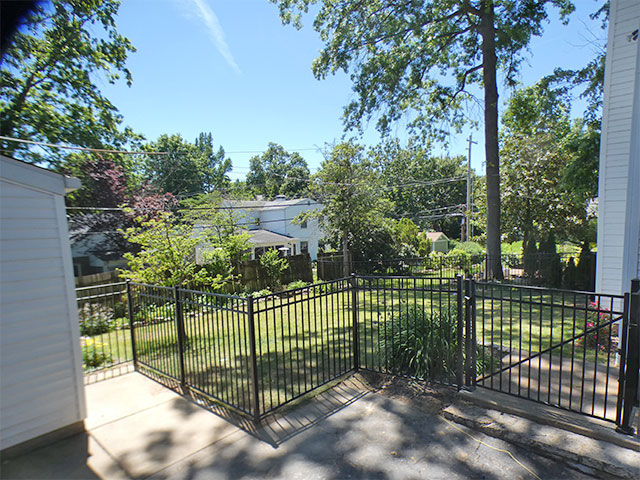
A slope is where dogs get out. The ground drops away under a straight section and leaves a gap at the bottom. The Criscione yard in Eureka had a steep side line. For that slope, we ordered rackable sections plus 1 offset section. The fence follows the grade, and the bottom stays close to the ground.
Her mid-size dog, it turned out, did not need a tighter dog style. The standard 3 13/16 inch spacing was enough, which saved her that upgrade. The job was 122 linear feet of 4-foot Elite aluminum with 1 gate. It took 2 days in August 2026. Windswept Farms, her subdivision, allows only approved styles.
Can one fence hold dogs and kids by a busy road?
The Weis home in Fenton is a corner lot close to a busy road, and the yard holds both dogs and children. White vinyl picket with 3 inch pickets set 3 15/16 inches apart kept both in without closing the yard off.
The Weis fence ran 131 linear feet at 4 feet tall with 3 gates, in 2 days in August 2026. One is a double drive gate our shop built with a 7 inch drop to match the slope.
How do you know the gap is small enough?
Check it against the dog. At the Emht home in Imperial, we brought a sample panel to the estimate. The owner checked the picket spacing against the smallest dog and confirmed it would work. The job was 160 linear feet of white vinyl spaced picket, 4 feet tall.
The install took 2 days in July 2026. Once the dogs were let into the yard, they had no spot left to slip out.
Frequently Asked Questions
How much does an invisible fence cost on average?
Around St. Louis, about $1,600 installed, and most people pay $950 to $2,500, based on Angi’s July 2026 figures. A do-it-yourself kit starts around $200. Each extra collar adds $50 to $150.
Are invisible fences cheaper than regular fences?
Yes, at the start. A 150-foot aluminum fence runs about $3,750 to $6,000 installed. That is 2 to 4 times the invisible fence average. After that, a fence has no collars, batteries or buried wire to replace.
Can a dog run through an invisible fence?
Yes. VCA notes that a dog set on chasing something, or scared by thunder, may cross the line. A cut wire or a dead collar battery can also leave the boundary open.
Does an invisible fence work when the power is out?
A wired system gets its signal from a box plugged in at the house. A power cut can turn the boundary off, unless the box has a battery backup. A dead collar battery turns it off for that one dog.
Will an invisible fence keep coyotes out?
No. Only a dog wearing the collar feels the boundary. Coyotes, stray dogs and people can walk right in. Keeping animals out takes a physical fence.
Is an invisible fence worth it?
An invisible fence can be worth it for a calm dog, a big open property, or a subdivision that bans fences. A physical fence is worth the extra cost for a dog that chases or bolts. It is also what keeps other animals out.
How to Decide
- Has your dog ever bolted after something? Then fence the yard. A collar will not hold a dog that has made up its mind to go.
- Do stray dogs or coyotes come through? Then fence it. A collar keeps nothing out.
- Does your subdivision allow a fence? If not, a collar system may be your only choice. If it does, ask which style is approved.
If a fence is the answer, we measure the line on site and help you pick a picket spacing that fits your dog. You can compare the styles in person at our Arnold showroom. Read what past customers said on our reviews page, or see our dog fence installation page.
Our own installation work is guaranteed for one year, and the fence materials carry their manufacturer’s warranty. We can usually come out for the estimate 1 to 4 days after you call. Each of the five fences above took 1 or 2 days to put in.
To book the free, no-obligation estimate visit, call 636-464-1144.