Skip to main content

An above ground pool fence is a barrier at least 48 inches tall that keeps children and pets away from the water. St. Louis County’s guide asks for a pool permit above 24 inches of water. It wants the barrier 48 inches high with no opening that passes a 4-inch ball, and it lets a 48-inch pool wall count as the barrier when the ladder is fenced.
This guide covers which permits apply, when the pool wall counts as the barrier, a five-question check for your pool and the gate numbers an inspector reads. Once you know what your pool needs, we can measure the yard and put a written price on pool fence installation in St. Louis.
Count the ladder first.
St. Louis County wants a ladder or steps enclosed by a barrier at least 48 inches high with a self-closing, self-latching, lockable gate. Taking the ladder away does not satisfy that rule.
Do Above Ground Pools Need Fences in St. Louis?
Usually a fence or a qualifying pool wall is part of the pool permit. The three places below do not use the same triggers.
| Where you live | What starts a pool permit | Who to call |
|---|---|---|
| City of St. Louis | A pool more than 24 inches deep, or more than 30 inches of wall height, with a surface of 250 square feet or more. Any pool with a permanently equipped water circulating system also needs one. A smaller above ground pool does not. | The Building Division. Its residential permit page lists the triggers. |
| St. Louis County, outside any city | An above ground pool deeper than 24 inches, larger than 250 square feet or fitted with a recirculation system. | The County’s Department of Transportation and Public Works. Its above ground pool guide is the page linked above. |
| A city inside the county | Your city may have its own pool code. | Your city’s building office. Ask which code it follows before you buy a fence. |
We checked these triggers against the County’s guide and the City’s permit page on October 15, 2026. The County’s guide is built on the 2015 residential building code, so ask your office which edition it uses today.
Can an Above Ground Pool Wall Be the Barrier?
Sometimes, when it passes three checks.
- 48 inches above grade. Measure on the outside, from the ground to the top of the wall.
- The ladder. The County wants it enclosed by a gated barrier. Locking or removing it alone is not enough there.
- A deck at the rim. It gives a path over the wall. Ask your building office before you build one.
- Measure the wall. The top must stand at least 48 inches above grade, measured on the outside. The County also accepts an approved barrier mounted on top of the pool to reach 48 inches. The federal safety guidelines say the gap between the pool’s top edge and the bottom of that barrier should be no more than 4 inches.
- Look for openings and footholds. No opening in the wall may pass a 4-inch sphere. A national pool standard, ANSI/PHTA/ICC-4 2025, Section 7.2.3.14, adds two things. The wall must stand on the ground all the way around, and the pool maker must confirm the wall may serve as a barrier.
- Deal with the ladder. The County’s guide says a ladder or steps must be enclosed by an approved barrier at least 48 inches high. The barrier needs a self-closing, self-latching, lockable gate, and removing the ladder does not satisfy the rule. The federal guidelines also allow a ladder that is locked, secured or removed. Any opening a locked or removed ladder leaves behind must still stop a 4-inch sphere.
When the County and the federal guidelines differ, follow the stricter one and ask your office.
Does Your Pool Need a Fence? Tap Your Pool
Five quick questions give you a first read on your pool. It is a place to start, not legal advice, and your building office has the last word.
| If this describes you | Do this |
|---|---|
| Your pool holds more than 24 inches of water. | Expect a permit in St. Louis County. In the city, a permit also depends on a 250 square foot surface or a wall taller than 30 inches. Call your office. |
| The wall stands 48 inches or more above grade. | In St. Louis County it can count as the barrier when nothing in it passes a 4-inch sphere. |
| The wall is under 48 inches. | Add an approved barrier on top to reach 48 inches, or fence the pool. |
| The ladder is permanent and always open. | Fence it with a self-closing, self-latching, lockable gate, or change the ladder. |
| The ladder locks or comes off. | The federal guidelines accept it. St. Louis County says removing it is not enough, so ask before you rely on it. |
| A deck touches the pool. | Ask your building office how it treats the deck before you build. |
Above Ground Pool Fence Requirements
These numbers come from St. Louis County’s guide and the federal safety guidelines. Your own city may be stricter, and the federal booklet notes that some places require 60 inches.
| Part of the barrier | What it says | Where it comes from |
|---|---|---|
| Height | At least 48 inches above grade, measured on the side facing away from the pool. | The County’s guide and the federal guidelines. |
| Openings | None that pass a 4-inch sphere, so a child cannot squeeze through or climb it. | The County’s guide and the federal guidelines. |
| Horizontal rails | When they sit less than 45 inches apart, put them on the pool side of the barrier. | The County’s guide. |
| Distance from the water | A ground-mounted barrier stands at least 20 inches from the water’s edge. | The County’s guide. |
| The house as one side | Doors that open to the pool need an audible alarm, or must be self-closing and self-latching. | The County’s guide. |
Above Ground Pool Gate Requirements
Check each point before inspection day.
- The release. Under 54 inches, it sits at least 3 inches below the top on the pool side.
- The swing. The gate opens away from the pool, then closes and latches by itself.
- It opens outward, away from the pool.
- It closes by itself and latches by itself.
- It has a locking device, and so does every other access gate.
- If the release sits less than 54 inches above the bottom of the gate, it has to be 3 inches or more under the gate’s top rail, on the pool side.
- No opening larger than a half inch may sit within 18 inches of the release.
Those gate points come from the federal guidelines, and the County’s guide asks for the same outward swing and self-closing, self-latching action.
Above Ground Pool Fence Ideas for a St. Louis Yard
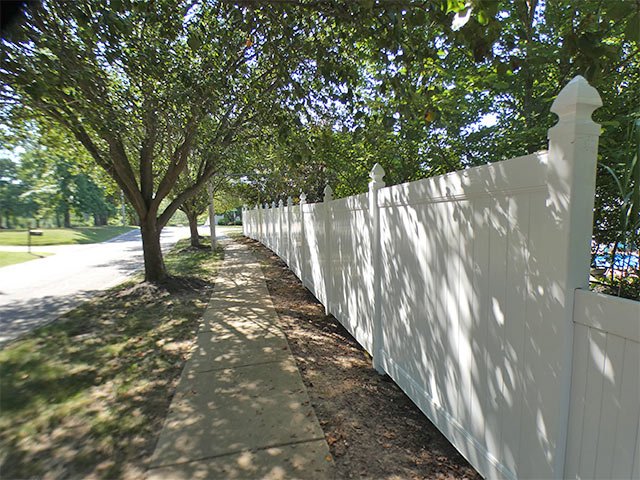
Aluminum and vinyl are two good choices for a pool yard, because the water, sun and chemicals will not wear them out.
The Elite EFF-20 aluminum residential fence is our most popular pool fence. It has a vertical picket design that suits pool codes, and it does not rust. The Bufftech Contemporary Baron vinyl fence has a 3-inch picket with 2 15/16-inch spacing and meets pool code in 4, 5 and 6 foot heights.
Prices depend on the style, the footage and the gate. Our guide to pool fence cost lists what moves the price, and our pool fence guide covers every pool type.
What to Tell a Fence Company Before the Estimate
Have these facts ready so the estimate matches your pool and your yard.
- The pool size and wall height. Give the diameter or the length and width, and the height of the wall on the outside.
- Where the ladder and any deck sit. They decide where the gate goes and whether a gated enclosure is needed.
- Which way the gate should open. It has to swing away from the pool.
- Your property line. A survey shows where it runs, and our land survey guide explains how to find one you own.
- Your HOA rules. Our HOA fence approval guide lists what to put in the packet.
- Underground lines. Missouri’s Public Service Commission wants the call 3 to 10 days ahead of digging, and it lists fences among the projects that need it. Missouri 811 locates the lines for free, and you can request a locate online or by dialing 811.
Call Maintenance-Free and describe your pool, and we will tell you what a fence around it involves.
Inspection Day Checklist for Your Pool Fence
Tick each item off. Your ticks stay on this device, and a print button makes a copy for inspection day.
- The top of the wall or fence is at least 48 inches above grade, measured on the outside.
- No opening passes a 4-inch sphere.
- The ladder is enclosed by a gated barrier at least 48 inches high, or my office has approved another way.
- The gate opens away from the pool.
- The gate closes and latches by itself and has a lock.
- A release under 54 inches sits 3 inches or more under the gate’s top rail, on the pool side.
- Horizontal rails less than 45 inches apart face the pool.
- A ground-mounted fence stands at least 20 inches from the water’s edge.
- Doors from the house to the pool have an alarm or close and latch by themselves.
- The permit, the site plan and the fence drawing are in my hands.
This guide is not legal advice, and you cannot use it to skip a permit or a call to your building office. It is not for a pool that belongs to an apartment building, a condo association or a business, so ask your building office which rules apply to those.
If your pool or fence has already failed an inspection, ask the inspector exactly which rule it missed before you change anything.
Want a price for a pool fence that meets your office’s rules? Book an on-site visit and we will measure around your pool.
Book an on-site estimate Prefer to talk first? Dial 636-464-1144
We have built fences in St. Louis since 1994. Learn what sets us apart on the Maintenance-Free Advantage page, or get to know Tim Kelley and the team first.
Pool Fence Questions, Answered
Do I need a permit for the fence itself in the City of St. Louis?
Yes for most new fences. The City’s residential permit page says all new fences of any type need a permit, and the one exception is replacing an existing fence at the same height, in the same material and in the same place in a rear or side yard. Call the Building Division before you order.
How far can the bottom of the fence sit above the ground?
The federal safety guidelines say the space under a barrier should be no more than 4 inches. Over grass or gravel the limit drops to 2 inches, and to 1 inch for a removable mesh fence. A yard that slopes needs extra care, because the gap changes along the fence.
What drawings does St. Louis County want with a pool permit?
The County’s guide asks for a plot plan that shows the pool and the barrier, plus the barrier’s location, material and height. It also asks for an elevation drawing and a section drawing of the fence. Ask the County for its current checklist before you apply.