Skip to main content


Aluminum wins for almost every yard, and true wrought iron is barely on the table anymore. Around St. Louis you will pay $20 to $45 a foot for aluminum put in, usually $25 to $40, and you will never paint it. What gets sold as wrought iron today is nearly always steel.
So the real choice is between aluminum and ornamental steel, both of which give you the wrought iron look. Some people call it rod iron. Same fence, same answer.
Maintenance-Free Outdoor Solutions has been installing fences around St. Louis since 1994, and the BBB lists the business start date if you want to check. You can also find us on the Catalyst Fence installer directory. See what an aluminum fence job looks like from first call to finished, or reach us at 636-464-1144 to get your visit scheduled.
Where the Old Ironwork Went
True wrought iron is a soft, fibrous iron that smiths once hammered and bent by hand. It has not been made in any real quantity for decades. Mild steel replaced it because steel is stronger, cheaper and far easier to make.
A fence sold as wrought iron today is nearly always steel, shaped and painted to look like the old work. That matters for one reason. Bare steel rusts, and so did the old iron. Once the paint chips, the rust starts, and you are back to a wire brush and a can of paint every few years.
Two metals give you the same look without that chore:
- Aluminum does not rust at all. The color is baked on at the factory.
- Ornamental steel is coated in layers at the factory to hold rust off, and it is the stronger of the two.
We install both metals across St. Louis and the Metro East. We do not sell hand-forged iron, and I would not steer you toward it unless you are restoring a historic house where the original work has to match.
Wrought Iron, Aluminum and Steel, Side by Side
Weight, rust risk and upkeep are what separate them once they are in the ground.
Wrought Iron
Heavy, strong and good-looking, and the most work to own. Iron and plain steel rust wherever the paint is broken, so an old iron fence needs scraping and repainting to stay sound. It is also slow to install, because the sections are heavy and are often welded on site.
Aluminum
Light, rust-proof and the least work of the three. Most of the aluminum you will see from us is Elite. You get 7 stock finishes to choose from, running from Black and White through Sandstone, Beige and Walnut Brown to Quaker Bronze and Hartford Green, and custom colors can be ordered. Elite backs it with a lifetime limited warranty. Every style is pictured on our Elite fencing page.
Aluminum is the one to pick for most back yards, pools and dog runs. It is lighter than steel, so it is quicker to hang, and nothing about it needs attention once it is up.
Ornamental Steel
The strongest of the three, and the one for security, commercial sites and steep ground. We install Ameristar, which comes in 3 grades: Montage for homes, Montage Plus for commercial sites and Montage II for industrial ones. Its panels are built to rack, so they follow a slope rather than stepping down it. Ameristar calls this All Terrain Flexibility, and a Montage panel will take up to 48 inches of rise across an 8 foot section. The steel is made in the USA, E-coated against rust and laser welded, and it looks the same from your side as from your neighbor’s.
Style matters as much as grade. Classic and Warrior give the traditional spear-top iron look. Majestic and Genesis are the two people choose most around pools, where 4 feet is usually tall enough. If your dog likes to jump, skip the pointed Warrior top and go with Crescent. Where security is the point, we set Montage on 5 to 6 foot posts, which makes it far harder to climb.
Steel costs more than aluminum, and our steel fence page covers when the extra is worth it. If steel against aluminum is the question you are stuck on, we wrote a separate guide to that choice.
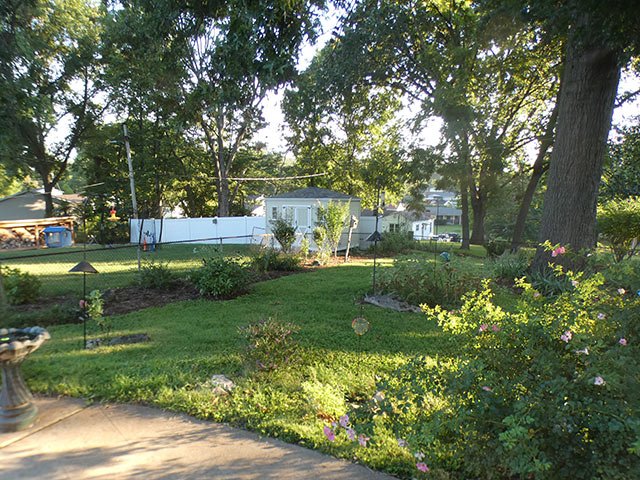
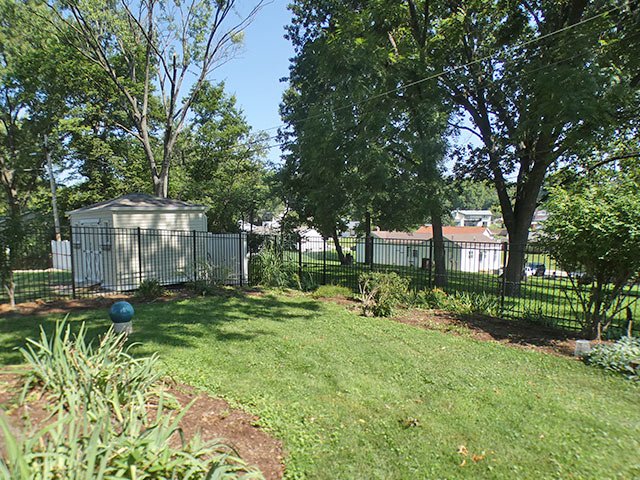
That photo is one of ours in St. Louis, built 6 feet tall in August 2026 to keep deer off a garden.
What Each One Costs
Our own installed range for aluminum around the St. Louis metro:
- Most homeowners pay $25 to $40 a foot. The full spread runs from $20 at the low end to $45 at the top.
- Every gate adds its own cost, because it brings hardware, a latch and time to hang it true.
- For the line-by-line figures, see our aluminum fence cost page. That page gets updated as prices move, so this one does not have to.
Ornamental steel sits above aluminum. How far above depends on the grade and the style, which is why we price it on site rather than in an article.
We do not install hand-forged wrought iron, so we will not quote it. A true iron fence is custom metalwork, priced by a blacksmith, and it will cost well above either metal we sell. Add the repainting every few years and the gap only grows.
Where a per-foot price stops helping. It cannot see a slope, a shared boundary, or a line that crosses an easement. You cannot price those from a map, and neither can we.
The Downsides of Aluminum, Plainly
It is the question people ask most after “is it cheaper”, so here it is from the company that sells it.
- Aluminum is not a privacy fence. Pickets have gaps. For screening you want solid vinyl or composite instead.
- It is lighter than steel. A car or a falling tree will bend it where steel might hold.
- Standard pickets let a small dog through. Closer spacing solves it and costs more.
- A 4 foot fence is a boundary, not a barrier. Anyone set on climbing it can.
If you need real security or you are fencing a commercial lot, those limits are the reason to step up to steel. For a family yard, none of them usually matters.
Aluminum That Copies the Old Ironwork
A lot of people search for a wrought iron aluminum fence, and that is exactly what modern aluminum is. The pickets, the rails, the spear or flat tops and the scroll details copy the old iron designs. From the sidewalk, most people cannot tell them apart.
The difference shows up years later. The iron look in aluminum is still the same color, with nothing flaking off the bottom rail where the sprinkler hits it.
If you want the look but not a yard fenced in, a 4 foot aluminum fence gives you the line and keeps the view. If you are comparing any metal against wood instead, our guide to metal and wood covers that.
What Real Aluminum Jobs Showed Us
How long an aluminum job takes comes down mostly to footage and gates. First, a quick look at 4 recent jobs. Each one answers a question people ask about aluminum against iron, and each one is measured.
- Can aluminum handle a steep yard? On the O’Malley pool fence in Barnhart, 15 May 2026, we found that ordinary gates would not sit square on the slope, so the gates we hung there rack to follow the ground. The pool fence itself ran 171 linear feet. It took 2.5 days, most of that spent getting the gates right on the grade.
- Will it match a subdivision’s approved style? The subdivision around the Criscione yard in Eureka allows one approved design, and nothing else gets built. Elite aluminum in matte black met it on the first try. It stands 4 feet tall with a single gate. The whole 122 foot run went in over 2 days in August 2026.
- Will aluminum hide a garden you just paid for? Not at 4.5 feet. The Stowe yard in Brentwood had fresh landscaping and dogs to keep in. A 100 foot run with 1 gate did both. It was up in 1 day, on 14 May 2026.
- Can it hold a small dog? Two little dogs could have slipped through a normal picket gap at the Voegtli house in Kirkwood. Tightening the spacing to 1 and 5/8 inches kept them in. It was a short 38 foot run with 2 gates, finished in 1 day in May 2026.
None of the four needed paint on day one, and none will need it later. That is the whole case against iron in one line.
Frequently Asked Questions
Is an aluminum fence cheaper than wrought iron?
Yes, on the day you buy it and every year after. You are looking at $20 to $45 a foot for aluminum in this area. True wrought iron is custom metalwork that costs well above that, and then asks for fresh paint every few years.
Why is wrought iron no longer used?
Mild steel replaced it decades ago, because steel is stronger, cheaper and easier to make. A fence sold as wrought iron today is nearly always steel shaped to look like the old work.
What are the disadvantages of a wrought iron fence?
Rust, weight and upkeep. Iron and plain steel rust wherever the paint breaks, so the fence needs scraping and repainting every few years. The sections are heavy, which makes it slow and costly to put in.
What is the average lifespan of an aluminum fence?
Longer than most people own the house. Aluminum cannot rust, and its finish is fused on at the factory rather than brushed on, so year twenty looks a lot like year one. Elite puts a lifetime limited warranty behind it.
Do aluminum fences increase property value?
Aluminum fences help resale, mostly because you hand the next owner a fence with no chores attached. An iron fence with rust on the rails reads as a job to them. For resale, black aluminum is the safe pick.
What type of fence needs the least maintenance?
Aluminum and vinyl, and it is close between them. Both need nothing more than a hose now and then. Iron, steel with broken paint, and wood all ask for regular work.
Which Fence Is Right for You?
Pick aluminum if you want the wrought iron look around a yard, a pool or a dog run, and you never want to paint it. All four jobs further down this page were exactly that.
Pick ornamental steel if you need real strength, you are fencing a commercial or industrial site, or the ground is steep enough that the panels need to rack.
Skip true wrought iron unless you are restoring an old house where the original ironwork has to match. For everyone else, you do not need it, and it will cost you more for more upkeep.
Doing it yourself is a real option too. Both metals are sold through our fence supply store, and you can set your own posts.
Want it done for you? You get a visit where the line is measured, a sample panel is held up against your house so you see the real color, and a price is written up before anyone leaves. Homeowners who went that route have left their comments on our reviews page.
The installation is guaranteed by us for one year. Elite’s lifetime limited warranty on the aluminum is separate and comes from Elite. The visit itself is usually 1 to 4 days out from your call. You can walk through our Arnold showroom and see the panel and gate styles firsthand before you decide.
To set up that free visit, ring 636-464-1144.