Skip to main content


To choose a commercial fence, decide what the fence must do first, then match the material to that job. Aluminum suits most offices, schools and apartment sites. Steel is the strongest pick, and vinyl screens what you do not want seen.
The sections below cover materials by site, a budget with sources, permits and fire access and how to compare bids. A commercial fence company in St. Louis can price your site once you know what you want.
If your worry is break-ins, read our guide to commercial security fencing first.
Decide what the fence must do before you compare materials.
Then plan the gates, because gates decide how the site works.
How to Choose a Commercial Fence: Start With the Job
A fence can do four jobs at a business. Most sites need two of them.
- Mark the line. It shows where your property ends.
- Screen the view. It hides dumpsters, equipment and loading areas.
- Control entry. It sends people and trucks through gates you choose.
- Look good. It sets the first impression for customers and tenants.
Write your two top jobs down before you call anyone. They decide whether you want an open fence or a solid one, and how strong it must be.
Commercial Fence Types: Which Material Fits Which Site
Since 1994 our business fences have used aluminum, ornamental steel or vinyl. This table shows which suits each kind of site, and where chain link is the better answer.
| Your site | What usually fits | Honest read |
|---|---|---|
| Office or retail | Black aluminum | An open, finished line that customers see first. It does not rust. |
| Apartments or an HOA | Aluminum or steel | Open styles keep sightlines clear for cameras and neighbors. Pick steel where you want it tougher. |
| School or child care | Open black aluminum or steel | Staff can watch the play area through it, and a locked gate keeps children in. |
| Restaurant or shop with a back lot | Solid vinyl at the back, aluminum at the front | Vinyl screens dumpsters and deliveries. See our post on restaurant fences. |
| Warehouse or storage yard | Chain link for the long run | We do not install chain link. Steel works well for the front and the gates. |
| A site with a high-risk threat | A system from a security specialist | Our security fencing guide explains why a fence is not enough. |
This table covers business sites only. A comparison of fence types covers fences in general.
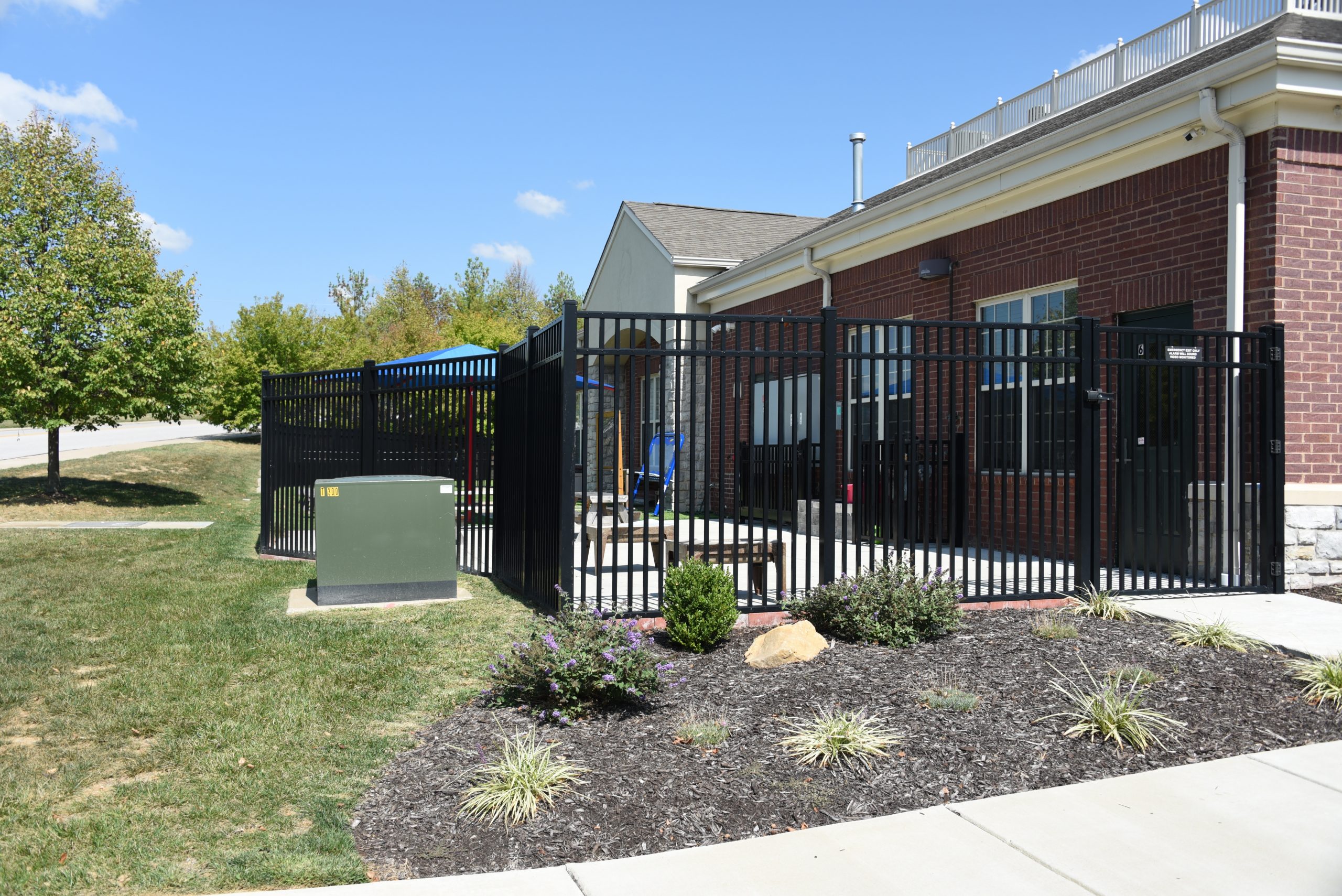
Commercial Fencing Materials: What Aluminum, Steel and Vinyl Do
Most business buyers end up choosing between these two. Vinyl is the third pick, for screening.
Aluminum
Our commercial grade aluminum fence has 1-1/8 by 1-3/4 inch rails and 3/4 inch pickets. Posts are 2 or 2-1/2 inches square. It comes in nine colors and in heights from 3 to 6 feet.
Aluminum will not rust, though it bends more easily than steel. See the commercial grade aluminum fence, or read how aluminum compares with wrought iron. We also sell and install Elite aluminum railing.
Ornamental steel
We install Ameristar steel in three grades. Montage is the home grade, Montage Plus is commercial grade and Montage II is industrial grade. Montage Plus has an optional fourth rail for extra strength.
Steel is the strongest of the three. See our steel fencing, or our aluminum vs steel guide.
Vinyl
Solid vinyl panels block the view of dumpsters, equipment and loading docks. Of the three materials, vinyl is the weakest, so it hides things without defending them.

For a close look at a finished aluminum job, see our matte black aluminum fence in Fenton, built with hidden fasteners.
How Much Does a Commercial Fence Cost? Plan the Budget
Start with order of magnitude, then let a site visit set the real number. These ranges come from our St. Louis cost guides, which are written for the usual picket or privacy fence. Heavier grades, long runs and extra gates move a business bid.
| Material | Installed, per foot | Where it comes from |
|---|---|---|
| Aluminum | $25 to $40 for most jobs | Our aluminum fence cost guide, built on Angi and Yelp data |
| Ornamental steel | About $29 to $50 | Our guide puts steel 15 to 25 percent above aluminum, so this is that rise applied to the aluminum range |
| Vinyl privacy | $55 to $65 typical, $45 to $75 across the metro | Our vinyl fence cost guide |
Do not compare the rows head to head. The vinyl number is for tall solid panels and the aluminum number is for the usual open style.
Here is a worked example. A 150 foot aluminum line at $25 to $40 a foot runs $3,750 to $6,000. Taking out an old fence adds about $225 to $750, at $1.50 to $5 a foot. That makes $3,975 to $6,750 before gates, permits and any slope.
Gates, permits and layout are the lines that make two bids differ. Ask for each one by name, as the bid list below shows. Our aluminum fence cost guide and vinyl fence cost guide go deeper on price.
Which Material Fits Your Business? Tap Your Answers
Pick your answers below and the checker suggests a material to ask about first. A visit to your site will tell you more than any checker can.
| Your situation | What to do |
|---|---|
| You need to mark a line or look good. | Choose an open aluminum fence in black or a color that matches your building. |
| You need to screen a view. | Choose solid vinyl for the back lot, and keep aluminum at the front. |
| You need to control who comes in. | Choose steel or aluminum with a locked gate. Steel is the stronger of the two. |
| Cameras or staff need a clear view of the line. | Choose an open style, not a solid panel. |
| Vehicles use the gate every day. | Plan on an automatic gate, and get the fire marshal’s view before you order. |
| You run a warehouse or storage yard. | Expect chain link for the long run. Steel works well for the front and the gates. |
Permits, 811 and Fire Access Before You Order
Three checks come before any post goes in the ground. Each one can delay a job that is otherwise ready.
The permit. New fences in the City of St. Louis need a permit, according to its residential permit page. That page is written for homes, so call the Building Division for the rule at your business address. The rules change from one city to the next, in St. Louis County and in the Illinois towns we serve.
Utility lines. Before any digging, the crew must call Missouri 811 so buried lines get marked. Plan on 3 to 10 days of notice, which is what the Public Service Commission asks for. On the Illinois side, call 811 as well.
Fire access. A fence gate can block a fire truck. Under the 2021 International Fire Code, the fire code official must approve a security gate that crosses a fire access road. The gate also needs an approved way to open in an emergency. Many fire districts adopt that code with changes, so ask yours.
Put three questions to your fire marshal before you order.
- Is the gate on a fire lane? A gate on a fire lane needs approval.
- Is a key box or a special lock required? Ask for the rule in writing.
- What if the power fails? An automatic gate needs a way to open when it does.
A full fence installation includes the gates. Each opening is planned with the fire marshal’s answers in hand.
How to Compare Fence Bids Line by Line
Two bids can show the same total and cover different work. Ask each bidder to show these eight lines, in writing.
- Footage and height. Both should match your own measure of the line.
- Product grade. For steel, ask whether it is home, commercial or industrial grade.
- Posts. Ask for the post size and how deep each one goes.
- Gates. Ask for the count, the width, the latch, the hinges and whether any is automatic.
- Finish and color. Ask how the finish is made and whether the color is standard.
- Removal. Ask whether the price includes taking out and hauling away an old fence.
- Permit and 811. Ask who pulls the permit and who calls before the crew digs.
- Warranty. Ask what covers the work and what covers the product, and get both in writing.
Skip any bid that comes without a visit. A price from a phone call cannot know your slope, your gates or your utility lines.
Ask us for the same eight lines. They come in writing after a visit, so you can set them next to any other bid.
Sites with a vehicle threat or a high-risk perimeter need a security specialist before anything else, so this guide does not fit them. It is also not a code ruling or a bid. Your city, your fire marshal and a written bid decide those.
Call and describe the site. You will get a straight answer on which material suits it.
Want a written price? Ask for a visit. We walk the property line with you, then send a written price. The visit is free, with no obligation. Our crew usually gets to you within 1 to 4 days, and every installation is backed by a one-year workmanship guarantee.
Book your site visit Prefer the phone? Call 636-464-1144
Maintenance-Free has built fences in the St. Louis area since 1994. Read about the Maintenance-Free Advantage, or meet Tim Kelley and the team. For more on materials, see our fencing options guide.
Fence Questions, Answered
What is the difference between a residential and a commercial fence?
The difference is the grade. Makers sell the same style in lighter and heavier builds, with thicker posts and rails in the heavier ones. Ameristar sells its steel as Montage for homes, Montage Plus for commercial sites and Montage II for industrial sites. Ask every bidder which grade is in the price.
Can a fence follow a slope?
Yes. Commercial grade aluminum fence comes in flat sections for level ground and in rackable sections for steeper ground. In a rackable section the pickets stay upright while the rails follow the slope. Tell the bidder where the grade changes, because the section type is chosen by slope.
Can I use two fence types on one site?
Yes, and many sites do. An open aluminum fence along the street can meet solid vinyl around the back lot. Matching the color keeps the two looking like one fence, and each stretch does its own job.
What gates can I get for a business fence?
Our commercial grade aluminum fence has matching single entry gates and double drive gates in each of its seven standard styles. Estate and curved top gates are also offered. Every gate has a key-lockable latch and self-closing hinges, and a self-latching latch is available on request.
What warranty comes with a fence installation?
The work of our installers is guaranteed for one year, counted from the day the job is finished. Makers set their own product warranties, and these differ by grade. Get the warranty for the exact grade you buy in writing before you sign.